Defund Fear by Zach Norris
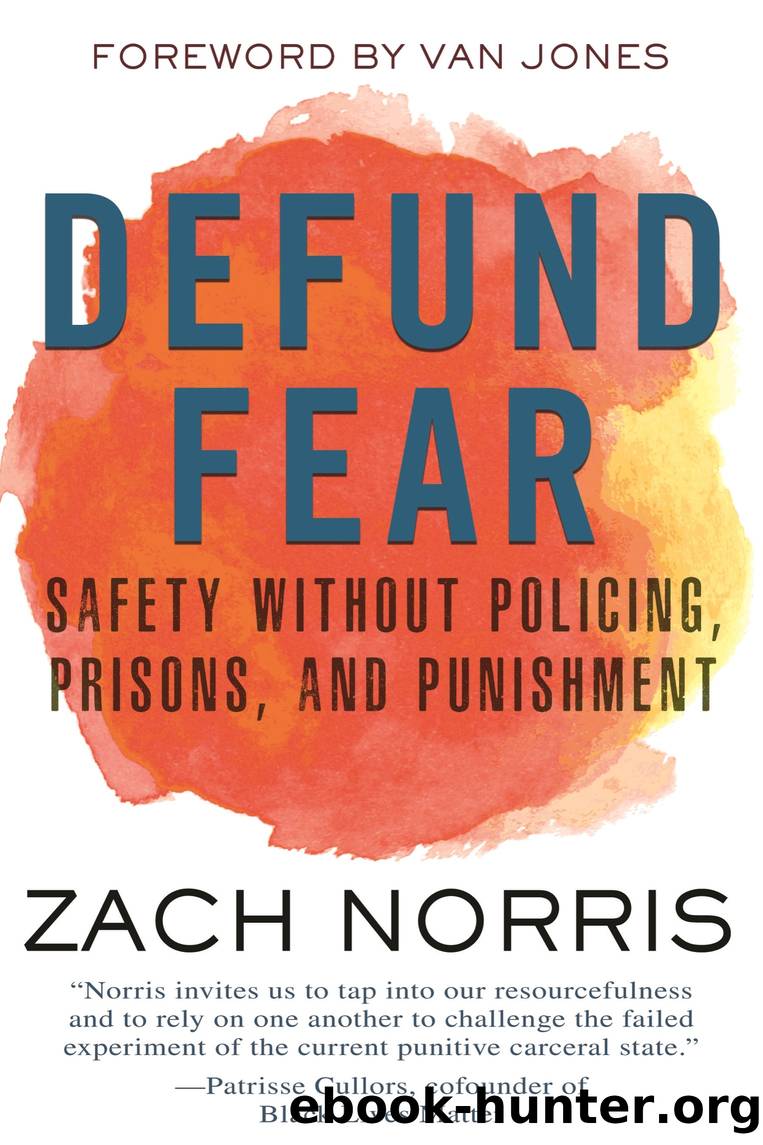
Author:Zach Norris [Norris, Zach]
Language: eng
Format: epub
Publisher: Beacon Press
Published: 2020-02-15T00:00:00+00:00
Things did not have to unfold like this, for Durrell or for so many youngsters like him.
Itâs not difficult to imagine a different outcome for him and for Allen. There are at least three turning points in his story that could have led to a happier ending for father and son, and their community. While this hypothetical reflection on alternate realities wonât help Durrell, it can be valuable as we set about creating a new model of public safety and accountability. After all, part of what makes us uniquely human is our capacity to be self-reflective about our past and present, and imagine a different kind of future.
The first turning point for Durrell was in school. Like so many children today, Durrell had been diagnosed with ADHD. He had stopped showing up for classes and then for school altogether. What would have held his interest in school? I donât believe thereâs any student so hopeless or apathetic that they canât be engaged in learning: itâs just a matter of figuring out what will hold their interest. We know for a fact that Durrell wasnât apathetic; we know that before he died, Durrell discovered a passion for landscape design. Is it beyond the realm of imagining that Durrellâs school could have offered ways for him to learn about gardening and design?
Recognizing the problems with the standardized âfactory model of educationââa result of schooling intended originally to train factory workers during the industrial eraâmore affluent schools have devoted more and more resources to personalized and project-based learning. Underinvestment in public schools, however, meant fewer innovations in learning and education. A 2019 report revealed that ânonwhite school districts receive $23 billion less than white districts, despite serving the same number of students.â4 Most public schools constantly have to do more with fewer and fewer resources, resulting in the decimation of arts, physical education, libraries, and other ânonessentials,â even as they struggle to attract and retain good teachers.
At the same time, however, many of these schools are investing in security systemsâeverything from metal detectors to security cameras to armed guardsâwith negligible or even counterproductive effects. Through the federal 1033 program, school police agencies around the country obtained surplus military equipment, such as powerful rifles, grenade launchers, and armored vehicles. At least twenty-two districts in eight states used 1033 before President Obama implemented restrictions on the program in 2015, but President Trump rescinded the restrictions in mid-2017, clearing the way for schools to once again obtain military equipment.
So why not take that money and invest it instead in, for example, experiential learning programs, including landscaping and gardening, which would provide the kind of hands-on, project-based learning and problem-solving experiences that many believe will best prepare our children for the future?
We even have models for schools where this is already happening. One example is Orchard Gardens, a public school in Roxbury, Massachusetts. At the pilot schoolâs opening in 2003, the community had high expectations. The building was clad in panels the deep yellow color of a school bus, with pops of red around the windows and doors.
Download
This site does not store any files on its server. We only index and link to content provided by other sites. Please contact the content providers to delete copyright contents if any and email us, we'll remove relevant links or contents immediately.
| Anthropology | Archaeology |
| Philosophy | Politics & Government |
| Social Sciences | Sociology |
| Women's Studies |
Cecilia; Or, Memoirs of an Heiress — Volume 1 by Fanny Burney(32558)
The Great Music City by Andrea Baker(32019)
Cecilia; Or, Memoirs of an Heiress — Volume 2 by Fanny Burney(31956)
Cecilia; Or, Memoirs of an Heiress — Volume 3 by Fanny Burney(31942)
We're Going to Need More Wine by Gabrielle Union(19046)
All the Missing Girls by Megan Miranda(16027)
Pimp by Iceberg Slim(14507)
For the Love of Europe by Rick Steves(14121)
Bombshells: Glamour Girls of a Lifetime by Sullivan Steve(14075)
Talking to Strangers by Malcolm Gladwell(13370)
Norse Mythology by Gaiman Neil(13365)
Fifty Shades Freed by E L James(13241)
Mindhunter: Inside the FBI's Elite Serial Crime Unit by John E. Douglas & Mark Olshaker(9343)
Crazy Rich Asians by Kevin Kwan(9292)
The Lost Art of Listening by Michael P. Nichols(7506)
Enlightenment Now: The Case for Reason, Science, Humanism, and Progress by Steven Pinker(7313)
The Four Agreements by Don Miguel Ruiz(6765)
Bad Blood by John Carreyrou(6621)
Weapons of Math Destruction by Cathy O'Neil(6280)
